
Cité de la Mer
Submarine, Titanic and deep-sea aquarium
What’s worth your time in Cherbourg
Allow four to five hours for the Cité de la Mer in the former transatlantic liner terminal and about an hour for the old town walk. Above the town stands Fort du Roule with the Musée de la Libération, while the Musée Thomas Henry in the arts centre Le Quasar shows paintings and sculpture from the 15th to the 20th century.
Submarine, Titanic and deep-sea aquarium
Liberation museum above the roadstead
No results found.
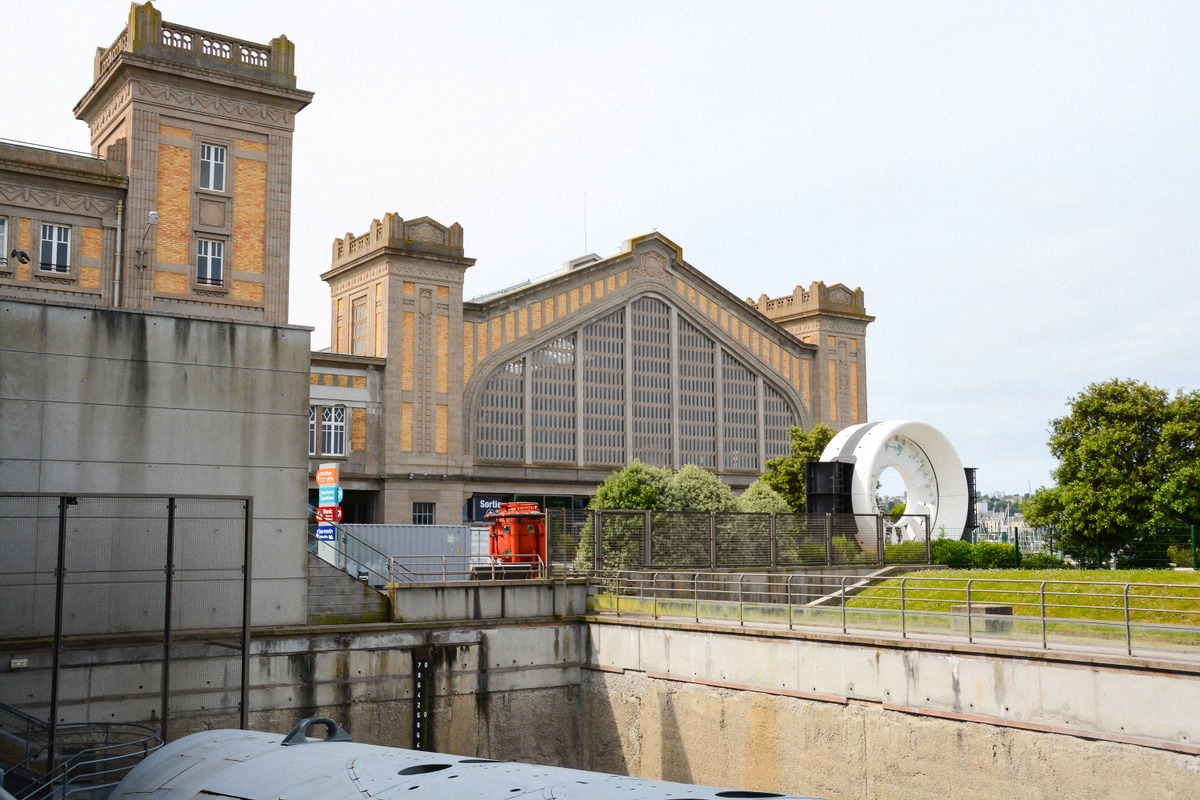
The Cité de la Mer occupies the former Gare maritime transatlantique on the harbour. Its highlights are the nuclear submarine Le Redoutable, the story of the Titanic’s call at Cherbourg and an aquarium 10.70 m deep. Allow four to five hours to see everything. Tickets are valid all day, so you can head back in after a lunch break.
The walk through the old town covers 3.0 km and takes about an hour. Along the way you pass Place du Général de Gaulle, the Théâtre à l'italienne and a filming location from “Les Parapluies de Cherbourg” (The Umbrellas of Cherbourg). Thursday is main market day on Place du Général de Gaulle.
Fort du Roule stands 117 m above the town, with views across the town and the roadstead. The harbour page shows how the ferry terminal, the cruise terminal and the Cité de la Mer relate to one another. If you’re arriving by cruise ship, Cherbourg cruise port explains how things work ashore.
The town has swimming beaches at Collignon and Querqueville, both lifeguarded from 1 July to 31 August. There’s more on the beaches page. For day trips on the Cotentin peninsula, see the pages on Barfleur, La Hague and day trips.
The Musée Thomas Henry is in the arts centre Le Quasar on Esplanade de la Laïcité. It was founded in 1835 on the bequest of Thomas Henry (1766-1836). The collection numbers around 300 paintings and sculptures from the 15th to the 20th century. Its holding of works by Millet is the second largest in France after the Musée d'Orsay’s. There are also works by Fra Angelico, Lippi, Jordaens, Chardin, Poussin, David and Philippe de Champaigne, and Signac’s “Le Phare de Gatteville”. The same arts centre is home to the artothèque (an art lending library) and the Bibliothèque Jacques Prévert.
The Musée Thomas Henry is open all year, Tuesday to Friday from 10:00 to 12:30 and 14:00 to 18:00, and on Saturdays and Sundays from 13:00 to 18:00. It’s closed on Mondays and public holidays and closes at 17:00 on 24 and 31 December. Entry is free on Wednesdays. Exceptions and closing days are listed on the museum’s website.
At Fort du Roule, the Musée de la Libération has told the story of the town’s liberation in 1944 and of everyday life for civilians and soldiers during the war since 1954. The museum opens seasonally: in 2026 from 7 February to 11 November, and in 2027 from 6 February to 11 November. Daily hours are the same as at the Musée Thomas Henry, and here too entry is free on Wednesdays.
In the old town, the umbrella factory on Quai Alexandre III has its own museum, open Monday to Saturday from 10:00 to 18:00. There’s more in the section Umbrellas from Cherbourg.
The Parc Emmanuel Liais on Rue de l'Abbaye is named after an astronomer with a passion for botany. Among its plants are a Tasmanian tree fern and a Monterey cypress more than 100 years old. The glasshouses, with a tropical forest, a cactus desert and a warm temperate section, are open Monday to Friday from 10:00 to 12:00 and 14:00 to 17:00, on Fridays until 16:30. The park itself is open every day, public holidays included, and carries the “Jardin remarquable” label. The Muséum Emmanuel-Liais is currently closed.
The Château des Ravalet in Tourlaville was built for Jean II de Ravalet. The town of Cherbourg bought the château in 1935, and it has been listed as a Monument historique since 1996. The main rooms are open to visitors without a guide only during the summer exhibition, Wednesday to Sunday from 13:30 to 18:30; at other times you can see them on a guided tour booked through the tourist office (Office de Tourisme). The 18-hectare park was redesigned in 1872 by Vicomte René de Tocqueville. It includes the 19th-century Rotonde-Serre glasshouse and has been a “Jardin remarquable” since 2004. The park is open every day.
The Jardin public on Avenue de Paris was laid out in 1887 on the site of a former hermitage. It has animal enclosures, plenty of play equipment, statues, ponds, a bandstand and a rose garden, and is open every day.
The Abbaye du Vœu was founded in 1145 at the wish of Empress Matilda (Mathilde l'Emperesse) and later served as barracks and a hospital. The Logis abbatial houses a small museum, and the abbey has been listed as a Monument historique since 2002. You can see inside on guided tours run by the tourist office and during the Journées du patrimoine (European Heritage Days).
Dogs are not allowed in the Parc Emmanuel Liais, the grounds of the Château des Ravalet or the Jardin public.