
Harbour
Roadstead, marina and harbour cruise
Behind the breakwaters of the roadstead lie the ferry terminal, the cruise terminal, the Cité de la Mer and the Port Chantereyne marina. The roadstead is one of the largest man-made roadsteads ever built. A harbour cruise lets you see it from the water.
On this page
The roadstead at Cherbourg
The roadstead at Cherbourg is a stretch of water of over 1,500 ha off the town, sheltered by breakwaters. It is one of the largest man-made roadsteads ever built. Locally the breakwaters are called digues. Behind them lie the ferry terminal, the cruise terminal, the fishing and commercial port and the Port Chantereyne marina.
The central breakwater took the longest to build: work began in 1783 and finished in 1853. With its forts it is 3.7 km long. The eastern breakwater followed in 1890-1894 and the western breakwater in 1889-1896. In the inner roadstead, the Digue du Homet (1899-1914) and the Digue des Flamands (1921-1922) were added.
For a view over the town and the roadstead, head up to Fort du Roule at 117 m. From Collignon beach, on the east side of town, you look out over the breakwaters and forts.
Breakwaters and forts
Several forts stand along the roadstead:
- to the west, the forts of Querqueville and Chavagnac
- on the central breakwater, one fort at each end and one in the middle
- to the east, the Fort de l'Île Pelée
The central breakwater, also known as the Digue du Large, was built out in the open sea from the late 18th century. It had a military role until the end of the Second World War. Since 2021 the breakwaters and forts have been protected as a Monument historique. Most belong to the French Navy (Marine nationale); the forts of Querqueville and Chavagnac are privately owned, and the Fort de l'Île Pelée belongs to Ports de Normandie.
Three ports in one bay
The port does several jobs side by side: fishing, with its own fish auction, commercial shipping, offshore energy, cruises and ferries to England and Ireland. The approach takes ships with a draught of up to 14 m and is open around the clock. Since 1 January 2022 the port has been run under concession by SPL Cherbourg Port.
For travellers, three areas matter:
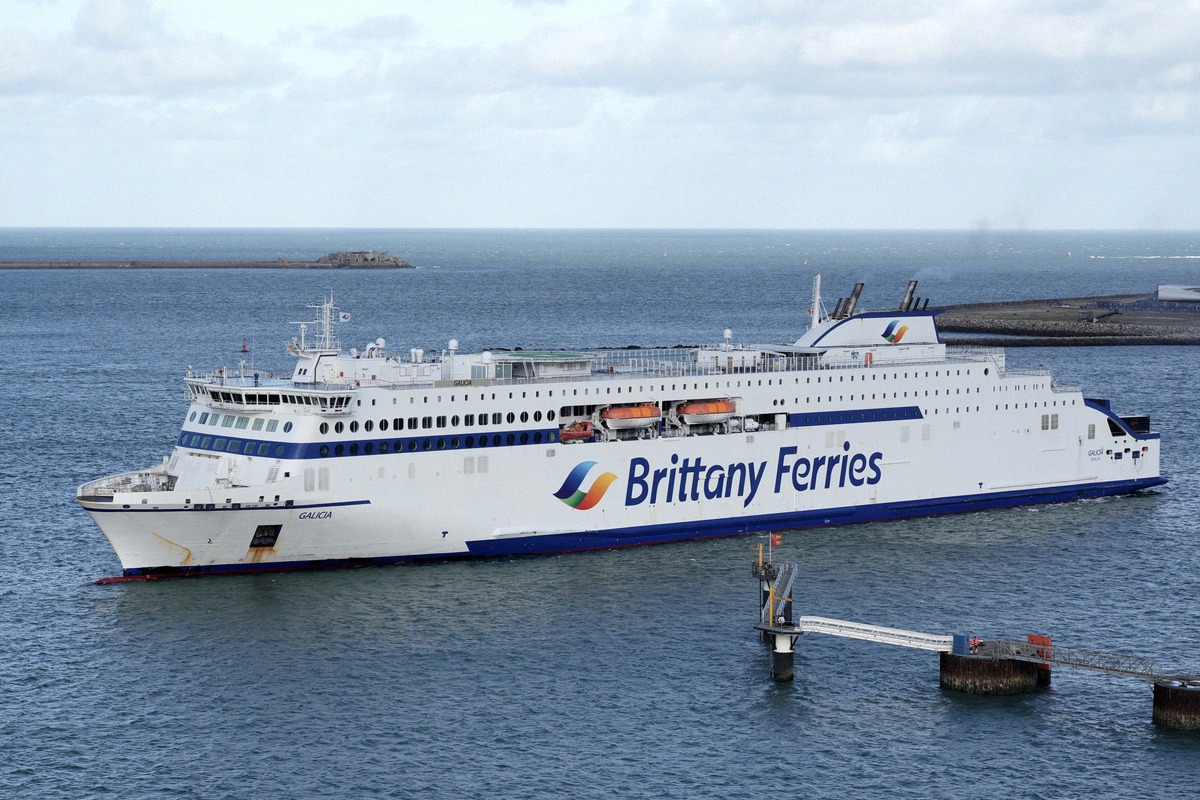
- Ferry terminal: the Gare maritime transmanche has been in service since June 1994. Brittany Ferries sails from here to Portsmouth and Rosslare, Irish Ferries to Dublin. Routes, check-in and getting there are covered on ferries from Cherbourg.
- Cruise terminal: cruise ships berth at Quai de France, around 600 m long. A covered footbridge leads straight into the former Gare maritime transatlantique. What you can fit into a short call is covered on Cherbourg cruise port.
- Marina: Port Chantereyne lies next to the historic centre and is the harbour for sailing and motor boats.
Gare maritime and Cité de la Mer
The Gare maritime transatlantique is an Art Deco building by the architect René Levavasseur. It opened in 1933, was destroyed in 1944 and rebuilt in 1952. It has been protected as a Monument historique since 1989.
In 2002 the Cité de la Mer opened in the building. It also serves as the cruise terminal: passengers arrive in the former baggage hall, which is now part of the Cité de la Mer. From here it is around 1.0 km as the crow flies to Place du Général de Gaulle in the old town.
Port Chantereyne
Port Chantereyne was founded in 1975 and has around 1,600 berths, 190 of them for visiting boats. They are spread over four basins: Bassin Chantereyne, Quai de Caligny, Bassin du Commerce and Port de l'Épi. You can enter around the clock whatever the tide.
Facilities include:
- a fuel station available 24 hours by card
- free Wi-Fi on the pontoons
- toilet and shower blocks in four places, all accessible
- a 40-tonne travel lift and free slipways
The marina holds the Blue Flag and the 5 Gold Anchors award. Regattas include the Drheam Cup in even years and the Rolex Fastnet Race in odd years. The harbour office (Bureau du port) is staffed daily from 08:00 to 21:00 in July and August, and from October to March Monday to Saturday from 08:00 to 12:00 and 13:30 to 17:00.
In front of the Bureau du port there is an e-bike hire station. The tourist office (Office de Tourisme) on Quai de Caligny is around 740 m away as the crow flies.
The roadstead from the water
Hague à Part runs harbour cruises around the roadstead. The trip takes around an hour, and the boat “Adèle” carries up to 82 people. It leaves from the Pont Tournant on Quai Lawton Collins in the centre or from the Cité de la Mer.
Dates and prices are on the tourist office’s listings page. As one departure point is at the Cité de la Mer, the trip also fits well into a cruise call: see Cherbourg cruise port.